
Editorial note: LoyaInsurance.org is an independent insurance information website. We publish guides to help drivers understand SR-22 filings, coverage options, and quote-shopping questions. Company names are used for identification and comparison purposes only.
Cheap SR-22 Insurance From Loya Insurance Company: What to Check Before You Buy
If you are searching for cheap SR-22 insurance from Loya Insurance Company or Fred Loya Insurance, the real goal is not just finding the lowest first payment. You need a policy that satisfies the SR-22 filing requirement, stays active without a lapse, and gives you a total cost you can realistically maintain.
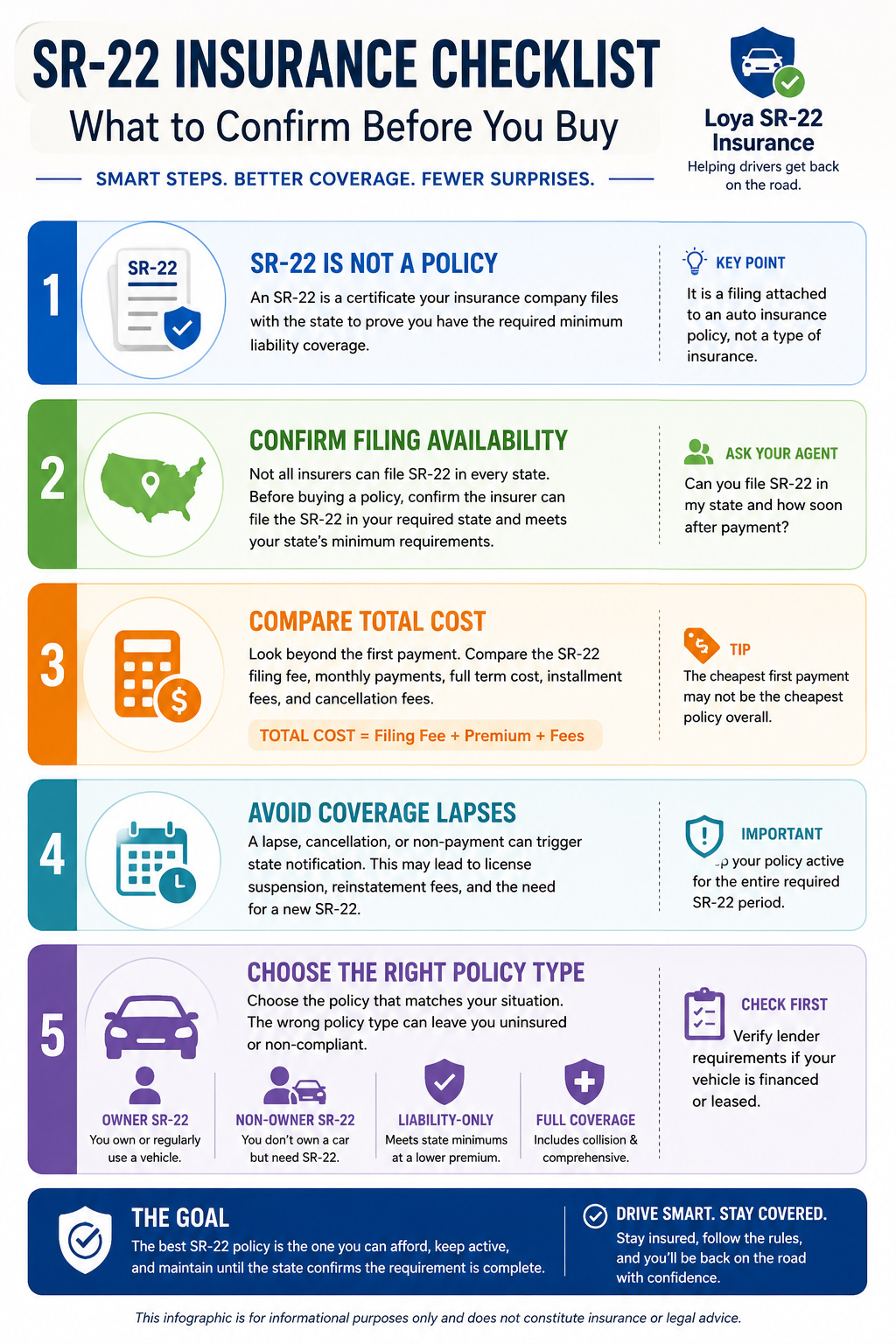
An SR-22 is not a separate type of car insurance. It is a certificate your insurance carrier files with the state to show that you are maintaining required motor vehicle liability insurance. Texas DPS explains that the insurer notifies the department if the SR-22 is canceled, terminated, or lapses [1].
That is why “cheap” SR-22 coverage should be judged by more than the monthly price. A policy that looks cheap but cancels after a missed payment can become expensive if it causes another suspension, reinstatement fee, or filing problem.
Best First Step
Ask whether the company can file the SR-22 in your state before comparing only the premium or down payment.
Most Important Rule
Keep the policy active for the required period. A lapse can trigger state notification and create new license problems.
Real Cheapness
The cheapest useful SR-22 policy is the one with a manageable total cost, correct filing, and no avoidable cancellation risk.
Can Fred Loya Help With SR-22 Insurance?
Fred Loya’s official SR-22 page says its agents can help with SR-22 certificates and customized auto insurance policies, including minimum auto insurance requirements and coverage options [2]. That makes the company relevant for drivers who need proof of financial responsibility after a violation, lapse, suspension, or other state requirement.
However, you should still confirm the details directly before buying. SR-22 rules vary by state, and the policy must match your situation. A driver who owns a car may need a different setup from a driver who needs a non-owner SR-22. A driver with a lender may also need more than state-minimum liability coverage.
Practical takeaway: Do not ask only, “How much is SR-22 insurance?” Ask, “Can you file the SR-22 in my state, when will it be filed, what happens if I miss a payment, and what is the total cost for the policy term?”
What Makes SR-22 Insurance Expensive?
The SR-22 filing itself is usually only one part of the cost. The bigger price increase often comes from the event that caused the filing requirement, such as a DUI, DWI, uninsured driving, serious ticket, accident, or license suspension.
If a DUI or similar serious violation triggered the filing requirement, the underlying insurance premium can become a bigger expense than the SR-22 filing itself. Finding more affordable insurance after a DUI starts with comparing equivalent coverage, payment requirements, and eligibility rather than assuming every insurer will price the violation the same way.
NAIC explains that auto insurance pricing involves underwriting, where insurers assess the risk of an applicant, and rating, where the insurer assigns a price based on the risk it believes it is taking [3]. For SR-22 drivers, the driving record and coverage history can matter a lot.
| Cost Factor | Why It Matters | How to Control It |
|---|---|---|
| SR-22 filing fee | This is the administrative cost for filing the certificate with the state. | Ask whether the fee is charged once, at renewal, or when changes are made. |
| Violation type | A DUI, lapse, uninsured accident, or serious ticket can raise the underlying premium. | Compare quotes and avoid new violations during the required filing period. |
| Policy type | Owner SR-22, non-owner SR-22, liability-only, and full coverage can have very different prices. | Choose the policy type that matches your vehicle ownership and lender requirements. |
| Payment plan | A low first payment may still come with installment fees or a higher total term cost. | Compare total policy cost, not only the deposit or first month. |
| Coverage lapse risk | A cancellation can trigger state notification and may restart suspension or reinstatement problems. | Use autopay, calendar reminders, and a payment plan you can realistically maintain. |
How to Get the Cheapest Useful SR-22 Policy
Cheap SR-22 insurance should not mean risky insurance. A very low payment can be attractive, but the policy needs to satisfy your filing requirement and remain active. Before choosing a policy, compare the real cost and the filing process.
Ask These Questions
- Can you file the SR-22 in my state?
- How soon is the SR-22 filed after payment?
- Is the filing fee separate from the premium?
- What is the total policy term cost?
- What happens if the policy cancels or lapses?
- Can I use a non-owner SR-22 if I do not own a car?
Ways to Lower Risk and Cost
- Choose liability-only coverage if it fits your legal and vehicle situation.
- Ask about autopay, paperless, or paid-in-full options.
- Drive a vehicle that is cheaper to insure.
- Avoid new tickets and accidents.
- Keep continuous coverage until the state confirms the SR-22 is no longer required.
- Compare again when the SR-22 period ends.
Drivers who need an SR-22 are often already paying more because of the violation or insurance history that triggered the filing. Ways to approach higher-risk insurance rates more effectively can help you compare total policy cost, payment terms, coverage, and available savings instead of focusing only on the first payment.
Owner SR-22 vs. Non-Owner SR-22
One common mistake is buying the wrong kind of policy. If you own a vehicle, you may need an owner policy that lists the car and includes the SR-22 filing. If you do not own a car, a non-owner policy may help satisfy the filing requirement while providing liability-focused coverage when you occasionally drive vehicles you do not own.
| Policy Type | Best For | Important Warning |
|---|---|---|
| Owner SR-22 | Drivers who own, register, or regularly use a specific vehicle. | If your vehicle is financed or leased, your lender may require collision and comprehensive coverage. |
| Non-owner SR-22 | Drivers who need SR-22 but do not own a vehicle. | It usually does not cover vehicles you own, vehicles in your household, or cars you use regularly. |
| Liability-only SR-22 | Drivers who need to meet state minimum requirements at a lower premium. | It does not pay for damage to your own vehicle after an at-fault crash. |
| Full-coverage SR-22 | Drivers who need liability plus collision and comprehensive coverage. | It costs more, but may be necessary for financed or higher-value vehicles. |
If you need an SR-22 but do not own a vehicle, the policy structure deserves special attention. How non-owner coverage works for drivers without their own vehicle can help clarify when this type of liability-focused policy may fit and which vehicle-use situations need additional verification.
Why Continuous Coverage Matters More Than the First Payment
SR-22 coverage is not something to treat casually. Texas DPS states that if SR-22 coverage lapses, the driver license or driving privilege can be re-suspended, and a new SR-22 plus a reinstatement fee may be required [4].
Even if your state uses different forms or timelines, the same general risk applies: the state wants proof that required coverage stays active. If the policy cancels, the insurer may notify the state, and the driver may have to solve the license problem again.
Do Not Miss Payments
Use payment reminders or autopay if available. A missed payment can create more trouble than the original filing fee.
Do Not Cancel Too Early
Wait until the DMV, court, or state agency confirms that the filing requirement is complete.
Do Not Switch Carelessly
If you change insurers, confirm the new SR-22 is filed before the old policy ends.
What to Have Ready Before Requesting a Loya SR-22 Quote
An SR-22 quote can move faster when you have the right information ready. The insurer or agency may need to understand your filing state, violation, vehicle status, prior coverage, and whether the SR-22 is required by a court, DMV, or another state authority.
| Information | Why It Is Needed | Tip |
|---|---|---|
| Driver’s license number | Used to identify the driver and match the filing requirement. | Have it ready even if your license is currently suspended. |
| State or court notice | Shows why the SR-22 is required and which state needs the filing. | Keep letters, case numbers, DMV instructions, and reinstatement notices. |
| Vehicle details | Needed if you own a vehicle or need an owner policy. | Prepare the VIN, year, make, model, and registration details. |
| Prior insurance history | Lapses or cancellations can affect eligibility and pricing. | Be honest about cancellation dates and prior coverage gaps. |
| Payment budget | The best SR-22 policy is one you can keep active. | Compare the full term cost and installment fees before accepting a quote. |
Cheap SR-22 Insurance Mistakes to Avoid
Many drivers focus only on getting the filing done quickly. That is understandable, especially if a license reinstatement depends on it. But the wrong shortcut can create a second problem later.
Shopping Mistakes
- Choosing the lowest first payment without checking the total cost.
- Not confirming whether the SR-22 can be filed in your required state.
- Buying an owner policy when a non-owner policy would fit better.
- Buying liability-only coverage when a lender requires full coverage.
- Ignoring installment fees, cancellation fees, or reinstatement fees.
Compliance Mistakes
- Letting the policy cancel during the SR-22 period.
- Switching insurers before the new filing is active.
- Moving to another state without asking how the filing should be handled.
- Assuming the SR-22 ends automatically without confirmation.
- Not opening notices from the insurer, DMV, or court.
If the SR-22 requirement followed a lapse or uninsured-driving violation, pay particular attention to the filing start date and continuous-coverage requirement. Another lapse during the required period can create additional reinstatement problems depending on state rules.
When Loya SR-22 Insurance May Be a Good Fit
Loya-related SR-22 coverage may be worth considering if you want an insurer or agency familiar with high-risk drivers, state-minimum coverage, nonstandard auto insurance, and SR-22 filing questions. It may also be useful if you prefer working with an agent instead of only using an online quote flow.
That said, it is still smart to compare. The cheapest option for one driver may not be the cheapest for another because violations, location, coverage level, vehicle, payment plan, and filing state can change the final price. The factors that can make Loya car insurance more affordable are worth comparing separately from the SR-22 filing itself.
Good Fit Scenario
You need quick help understanding whether an SR-22 filing can be attached to a basic liability policy.
Compare Scenario
You have a serious violation and want to see whether another high-risk insurer offers a lower total policy cost.
Careful Scenario
You only see a low first payment but are not sure about fees, cancellation rules, or total term cost.
What Happens When the SR-22 Period Ends?
When your SR-22 requirement is close to ending, do not cancel the policy or remove the filing without confirmation. First, check with the state DMV, court, or agency that required the SR-22. Then ask the insurer how to remove the filing after the requirement is complete.
- Confirm the required end date with the DMV, court, or state agency.
- Ask the insurer whether the SR-22 can be removed after that date.
- Keep the policy active during the transition.
- Compare quotes again after the filing is removed.
- Continue maintaining insurance so your record can improve over time.
Cheap Loya SR-22 Insurance FAQs
Is SR-22 insurance a separate policy?
No. SR-22 is a filing attached to an auto insurance policy. The policy provides the coverage, while the SR-22 certificate proves to the state that required liability coverage is active.
Does Fred Loya offer SR-22 help?
Fred Loya has an official SR-22 information page and says its agents can help with SR-22 certificates and customized auto insurance policies. You should still confirm availability, filing timing, and state-specific requirements before buying.
What is the cheapest way to keep SR-22 coverage active?
The cheapest practical option is usually the lowest total-cost policy that satisfies your filing requirement and fits your vehicle situation. A very low first payment may not be best if the full term cost, fees, or lapse risk are high.
Can I get SR-22 insurance if I do not own a car?
Many drivers who do not own a vehicle use a non-owner SR-22 policy. This can help satisfy the filing requirement, but it usually does not cover cars you own, cars in your household, or vehicles you use regularly.
Can I switch insurers while I have an SR-22?
Yes, but timing matters. Make sure the new policy and SR-22 filing are active before the old policy ends so you do not create a lapse.
Do I need full coverage with SR-22?
Not always. Some drivers only need liability coverage to meet state requirements, but a lender may require collision and comprehensive if the vehicle is financed or leased.
Final Thoughts on Cheap SR-22 Insurance From Loya
Cheap SR-22 insurance from Loya Insurance Company or any other provider should be measured by the full picture: filing availability, total policy cost, payment reliability, coverage type, and lapse protection. The lowest first payment is not always the cheapest outcome if it leads to cancellation or another reinstatement problem.
Before you buy, confirm the filing state, policy type, total cost, payment schedule, and what happens if the policy cancels. Once the SR-22 is active, stay organized and keep coverage continuous until the state confirms the requirement is finished.
References
- Texas Department of Public Safety, “Financial Responsibility Insurance Certificate (SR-22).” Source↩
- Fred Loya Insurance, “SR-22 Insurance: Process, Cost, Validity & Who Needs It.” Source↩
- NAIC, “Auto Insurance.” Source↩
- Texas Department of Public Safety, “Section 9: SR-22 Proof of Financial Responsibility.” Source↩