
Commercial auto insurance can be an essential part of running a business that relies on vehicles. Whether you operate a contracting business, deliver goods, provide mobile services, or use a single work truck for daily operations, your vehicle can become one of your most important business assets.
Personal auto insurance is usually built for personal driving, not business operations. NAIC warns small business owners to review personal auto provisions carefully because business-related liability may be excluded when vehicles are used for business [1]. That is why many businesses need a commercial auto policy or related business auto coverage.
Businesses that own, lease, or regularly use vehicles for work.
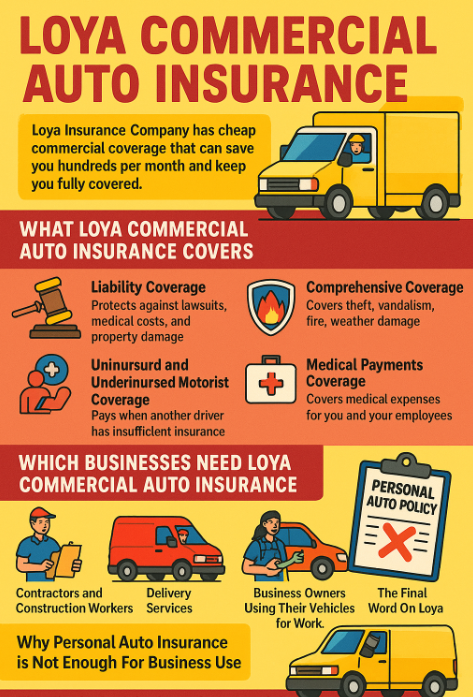
Liability coverage for injuries or property damage caused by business vehicle use.
Collision, comprehensive, medical payments, UM/UIM, towing, and hired/non-owned coverage.
Using a personal policy for business driving can create claim problems.
Important: Commercial auto insurance rules, available coverages, filing requirements, limits, deductibles, and business eligibility can vary by state, insurer, vehicle type, and business activity. Review policy terms carefully and confirm details with a licensed representative before relying on any coverage.
What Loya Commercial Auto Insurance Is Designed to Do
Loya commercial auto insurance is designed for vehicles used in business operations. That can include vehicles owned by a company, vehicles leased by a business, or in some cases vehicles used by owners or employees for work-related tasks.
The Insurance Information Institute explains that if you or your employees drive company-owned vehicles, your business likely needs commercial auto insurance. It also notes that if you use a personal vehicle for work purposes such as client meetings, business errands, or deliveries, you may need hired and non-owned auto coverage [2].
Business Vehicle Liability
Helps protect the business if a covered driver causes injuries or property damage while using a vehicle for work.
Vehicle Protection
Collision and comprehensive can help repair or replace business vehicles after covered damage, subject to deductibles and policy terms.
Operational Continuity
Coverage can help reduce disruption after an accident, theft, vandalism, weather event, or other covered vehicle loss.
What Loya Commercial Auto Insurance May Cover
Commercial auto policies can include similar coverage categories as a personal auto policy, but they are written for business use and often carry different limits, underwriting rules, and exclusions. The exact policy matters, but common coverage categories include the following.
| Coverage | What It May Help Pay For | Business Note |
|---|---|---|
| Commercial Auto Liability | Injuries, property damage, legal defense, or settlements after a covered at-fault accident. | Businesses often need higher limits than personal drivers because claims can involve employees, customers, cargo, or job-site property. |
| Collision Coverage | Damage to a covered business vehicle after a crash with another vehicle or object. | Useful for vans, trucks, service vehicles, and other vehicles that are expensive to repair or replace. |
| Comprehensive Coverage | Theft, vandalism, fire, hail, falling objects, certain glass claims, animal damage, or other non-collision losses. | Important for vehicles stored outdoors, parked at job sites, or carrying visible business branding. |
| UM/UIM Coverage | Injuries or losses caused by uninsured or underinsured drivers, where available. | Rules vary by state and policy, so check whether it applies to employees and covered vehicles. |
| Medical Payments or PIP | Medical costs for covered drivers or passengers, depending on state rules. | Availability and requirements vary widely by state. |
| Hired and Non-Owned Auto | Liability exposure when employees use personal vehicles, rented vehicles, or borrowed vehicles for business tasks. | This may be important if employees run errands, visit clients, or make deliveries using their own cars. |
Which Businesses May Need Commercial Auto Insurance?
Commercial auto insurance is commonly needed when vehicles are used for work-related purposes beyond ordinary commuting. A small business does not need a large fleet to have commercial auto exposure. Even one vehicle used for job sites, client visits, delivery, or tool transport can create business-related risk.
Common Business Types
- Contractors and construction workers.
- Electricians, plumbers, HVAC technicians, and handymen.
- Cleaning businesses and mobile service providers.
- Delivery businesses and courier operations.
- Landscaping, pest control, or maintenance companies.
- Small businesses with employees driving company vehicles.
Common Vehicle Types
- Work trucks.
- Service vans.
- Pickup trucks used for job sites.
- Box trucks or cargo vans.
- Personal vehicles used regularly for business tasks.
- Rented or borrowed vehicles used for company errands.
Why Personal Auto Insurance May Not Be Enough
Many business owners assume a personal auto policy will cover business driving, especially if the vehicle is also used for family or personal errands. That assumption can be risky. Personal policies may exclude certain business uses or may not carry enough limits for a serious business-related accident.
NAIC specifically advises small business owners to review personal auto and liability insurance provisions closely when vehicles are used for business because business-related liability may be excluded [1]. Progressive Commercial also notes that personal auto policies often exclude business use, which can leave staff and the company exposed when employees use vehicles for work [3].
Commercial Auto vs. Personal Auto Insurance
The difference is not only the name of the policy. Commercial auto insurance is written around business use, business liability, employees, and vehicles used for operations. Personal auto insurance is usually written for private household driving.
| Question | Personal Auto | Commercial Auto |
|---|---|---|
| Who is the policy designed for? | Individual or household driving. | Business owners, companies, employees, and work vehicles. |
| Can it cover employee drivers? | Usually limited to listed or permitted personal-use drivers. | Can be structured for employees or authorized business drivers. |
| Can it cover deliveries or job-site driving? | Often excluded or limited. | Designed for business-related driving when properly disclosed. |
| Can it include higher liability limits? | Sometimes, but within personal policy structures. | Often better suited for higher business liability exposure. |
| Can it cover hired or non-owned vehicles? | Usually not as a business solution. | May be available as hired/non-owned auto coverage. |
How Loya May Determine Commercial Auto Insurance Rates
Commercial auto pricing is usually more complex than personal auto pricing because the insurer must evaluate both the driver risk and the business operation. Employee driving history also matters because past accidents can affect future insurance rates as the insurer evaluates the overall risk of the drivers using the vehicles.
Business Type
Delivery, contracting, construction, and mobile services may carry different risks because of mileage, stopping patterns, and job-site exposure.
Vehicle Type
Work trucks, vans, specialty vehicles, and heavier vehicles can cost more to repair and may cause more severe damage in a crash.
Driver Records
Clean employee driving records can help reduce risk, while accidents, tickets, or suspensions can increase premiums.
| Pricing Factor | Why It Matters | Business Action |
|---|---|---|
| Industry and Operations | Different industries have different road exposure, cargo exposure, and customer interaction risk. | Describe business use accurately when quoting. |
| Vehicle Weight and Value | Heavier or more expensive vehicles can increase repair costs and accident severity. | Keep accurate vehicle details and VINs ready. |
| Mileage and Territory | More miles and higher-traffic routes generally mean more accident exposure. | Estimate local, regional, or long-distance use honestly. |
| Employee Driving Records | Drivers with accidents or violations can increase risk. | Check motor vehicle records where allowed and maintain safe-driver standards. |
| Vehicle Storage | Secure garages, monitored lots, or locked storage may reduce theft and vandalism risk. | Store vehicles in safer locations when possible. |
| Limits and Deductibles | Higher liability limits and lower deductibles usually increase premium. | Choose limits based on realistic business risk, not only the cheapest quote. |
Deductibles also determine how much the business must absorb after a covered loss, so how auto insurance deductibles affect claim costs should be considered alongside any premium savings.
Hired and Non-Owned Auto Coverage
Not every business vehicle exposure involves a company-owned vehicle. If employees use their personal cars for business errands, deliveries, client visits, or other work tasks, your business may need hired and non-owned auto coverage. Progressive Commercial explains that non-owned car insurance can help when employees use their own vehicles for work, because personal auto policies often exclude business use [3].
Hired Auto
Can apply when the business rents, leases, or hires vehicles for business use, subject to policy terms.
Non-Owned Auto
Can apply when employees use personal vehicles for business tasks and the business faces liability exposure.
Business hired and non-owned coverage is different from non-owner insurance for drivers without a car, which is generally built around an individual driver rather than a company’s business-use exposure.
Common Mistakes Businesses Make With Commercial Auto Coverage
Small businesses often create gaps unintentionally. Sometimes the owner believes the personal auto policy is enough. Sometimes employees use their own vehicles for company errands without the business realizing it has exposure. Sometimes the company grows but the policy is not updated.
- Using personal auto insurance for business driving. This can create denied-claim risk if business use is excluded.
- Letting unapproved employees drive. Driver eligibility and records matter on commercial policies.
- Buying limits that are too low. Business accidents can involve lawsuits, customer property, tools, cargo, or multiple injured people.
- Ignoring hired and non-owned exposure. Employee-owned vehicles used for company tasks can still create business liability.
- Not covering tools or equipment correctly. Commercial auto may not automatically cover everything carried inside the vehicle.
- Choosing deductibles the business cannot afford. A high deductible may reduce premium but hurt cash flow after a loss.
How to Maximize the Value of a Commercial Auto Policy
A commercial auto policy works best when it reflects how the business actually operates. Accurate drivers, vehicles, usage, limits, and deductibles also make comparing insurance quotes on the same terms more meaningful.
Cost-Control Steps
- Maintain clean driver records.
- Use written safe-driving rules for employees.
- Keep vehicles well maintained.
- Store vehicles securely when possible.
- Review deductibles and limits annually.
- Ask about discounts or payment options.
Coverage-Quality Steps
- Disclose all business uses honestly.
- Add new vehicles before they are used.
- List or approve employee drivers properly.
- Ask about hired and non-owned auto coverage.
- Review whether tools, equipment, or cargo need separate coverage.
- Update the policy when the business expands.
Filing a Claim After a Business Vehicle Accident
If a covered vehicle is involved in an accident, report the claim quickly and collect basic information such as driver details, vehicle details, photos, location, police report information, witness names, and business-use context. Fred Loya’s claims page says customers can report a claim to Loya Insurance Group at 1-800-880-0472 and lists claims office hours [4].
When a claim needs to be reported or followed up, Loya claims contact information can help confirm the current phone number and reporting details.
The Final Word on Loya Commercial Auto Insurance
Loya commercial auto insurance may be useful for business owners who rely on vehicles for daily operations, service calls, job-site travel, deliveries, or employee driving. The key is understanding that business driving is not always covered by a personal auto policy, and a single uncovered accident can create major financial risk.
Before choosing a policy, review how your vehicles are used, who drives them, whether employees use personal vehicles for work, what liability limits your business needs, and whether you need physical damage coverage for owned or leased vehicles. A strong commercial auto policy should protect both your vehicles and your business continuity.