
Loya Insurance Coverage Types: Liability, Full Coverage, UM/UIM, PIP and SR-22
Loya Insurance coverage types are usually built around practical auto insurance options for drivers who need to meet state requirements, protect a financed vehicle, compare full coverage, or file an SR-22 after a serious violation.
The right policy depends on your state, vehicle, lender requirements, driving record, and how much financial risk you can realistically carry yourself. A low first payment may look attractive, but limits, deductibles, excluded coverages, and filing requirements matter just as much.
For a broader company overview, review Loya car insurance before comparing coverage types.
What Auto Insurance Coverage Usually Includes
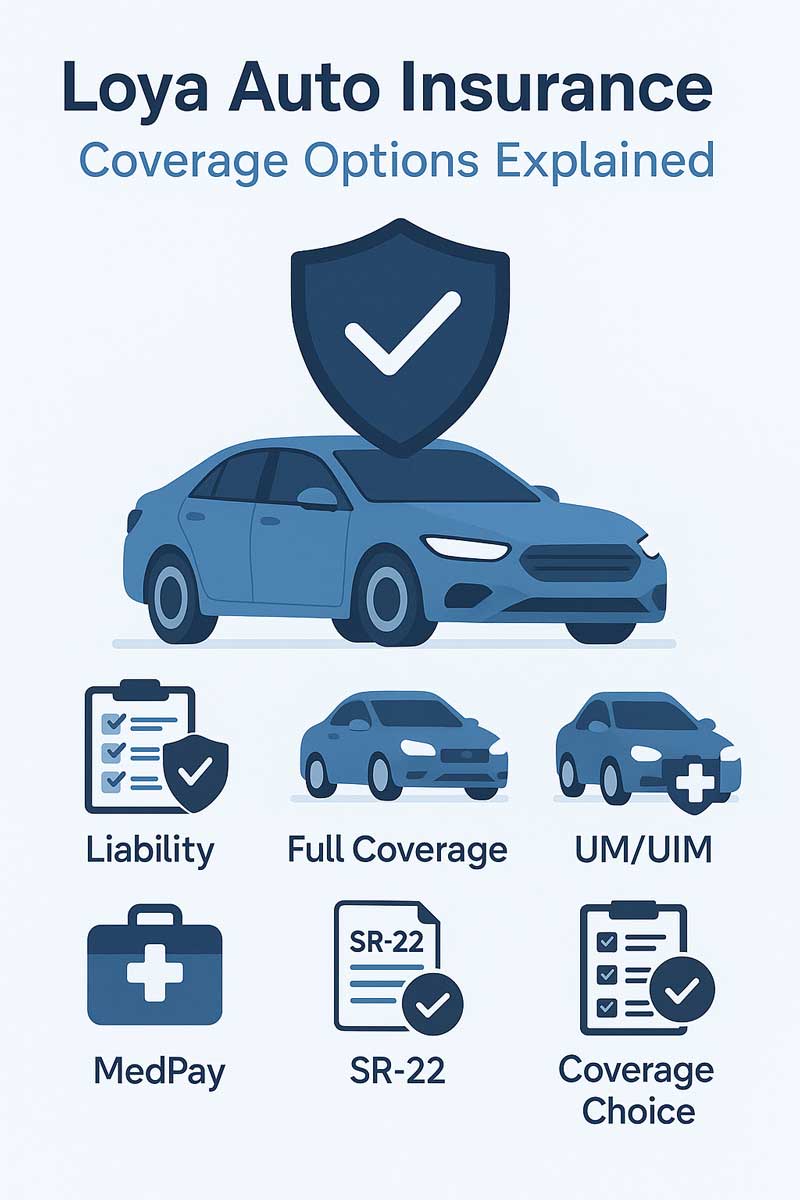
Auto insurance is usually divided into coverage that protects other people when you cause damage and coverage that protects you, your passengers, or your vehicle. NAIC explains that most states require some type of auto insurance to drive legally, and that auto insurance can generally be divided into liability and property damage coverage [1].
Loya is often considered by drivers who want straightforward coverage, need a lower upfront payment, or have high-risk factors such as tickets, accidents, a lapse in insurance, or an SR-22 requirement. Before choosing a policy, compare the available options with your state’s minimum requirements and your real financial risk.
Lowest-cost option
Liability-only coverage can help you meet state insurance requirements, but it does not pay to repair or replace your own car after an accident you cause.
Vehicle protection
Collision and comprehensive coverage can help protect your own vehicle, especially if it is financed, leased, newer, or difficult to replace.
High-risk support
Drivers who need SR-22 filings should confirm filing fees, timing, cancellation rules, and required liability limits before buying.
State Minimum Liability Coverage
Liability insurance is the foundation of most auto policies. It pays for injuries or property damage you cause to other people, up to your policy limits. It does not pay to repair your own car, replace your vehicle, or cover your own injuries unless another coverage applies.
Every state sets its own liability requirements. A policy may show limits as three numbers, such as bodily injury per person, bodily injury per accident, and property damage per accident. Texas explains that liability coverage pays to repair the other driver’s car and pays medical bills for the other driver and passengers when you are at fault [2].
| Liability-only question | Why it matters | What to confirm |
|---|---|---|
| Is the vehicle financed or leased? | Lenders often require physical damage coverage even when the state does not. | Ask your lender whether collision and comprehensive are required. |
| Can you replace your car yourself? | Liability-only does not pay to repair your own car after an at-fault crash. | Compare the premium savings against the car’s value and repair risk. |
| Are the liability limits realistic? | Minimum limits may satisfy state law but can be too low after a serious crash. | Quote higher limits to see whether the monthly increase is manageable. |
If you are comparing liability-only policies, read Loya liability car insurance so you understand what this coverage does and does not include.
Liability-Only May Work When…
- Your vehicle is older and paid off.
- You mainly need proof of insurance to drive legally.
- You can afford your own repairs after an accident.
- Your lender does not require comprehensive and collision.
- You understand that your own vehicle is not protected by liability coverage.
Full Coverage: Collision and Comprehensive
“Full coverage” is not a single coverage type. It usually means a policy that includes liability plus physical damage coverage for your own vehicle. NAIC explains that collision coverage pays for physical damage to your car when it collides with an object, while comprehensive coverage pays for damage from non-collision losses such as theft, fire, vandalism, falling objects, or animal damage [3].
Collision and comprehensive often have deductibles. A higher deductible may lower the premium, but it also increases your out-of-pocket cost after a covered claim. If you need more protection for your own car, review Loya full coverage insurance before choosing a deductible or removing physical damage coverage.
Collision coverage
May help repair or replace your car after a covered collision with another car, object, guardrail, wall, or single-car rollover, depending on policy terms.
Comprehensive coverage
May help with covered non-collision events such as theft, vandalism, hail, fire, falling objects, animal damage, or certain weather-related losses.
Coverage Types at a Glance
Use this table to compare which coverage responds to which kind of loss. The exact wording, limits, deductibles, and exclusions depend on the policy and state.
The biggest mistake is assuming “full coverage” covers every possible loss. It does not. It usually describes a bundle of liability, collision, and comprehensive coverage, but you still need to check UM/UIM, PIP, MedPay, rental, towing, and any exclusions separately.
| Coverage type | What it usually helps cover | When it matters most |
|---|---|---|
| Liability | Injuries and property damage you cause to others, up to your selected limits. | Required in most states and essential for legal driving. |
| Collision | Damage to your own vehicle after a collision with another vehicle or object. | Useful for financed, leased, newer, or hard-to-replace vehicles. |
| Comprehensive | Non-collision damage such as theft, fire, hail, vandalism, falling objects, and some weather events. | Useful if your car has meaningful value or is exposed to theft, storms, or other non-crash risks. |
| UM/UIM | Losses caused by a driver with no insurance or not enough insurance, depending on your state and policy. | Important in areas with many uninsured or minimum-limit drivers. |
| PIP or MedPay | Medical costs after an accident, with rules that vary by state. | Helpful if you want medical bill protection regardless of who is at fault. |
| SR-22 filing | A state filing showing you maintain required auto liability insurance. | Needed after certain violations, suspensions, or uninsured-driving situations. |
Uninsured and Underinsured Motorist Coverage
Uninsured and underinsured motorist coverage are designed to help when another driver causes an accident but has no insurance or does not have enough insurance. Texas explains that UM/UIM pays if you are hit by someone who did not have insurance or did not have enough to pay your medical and car repair bills, and that it can also apply to hit-and-run accidents [2].
Rules vary by state, so do not assume UM/UIM is automatically included. Ask whether it is included, what limits apply, whether property damage is included, and whether you must sign a rejection form if you decline it. For a deeper explanation, read uninsured and underinsured coverage explained.
UMBI
Uninsured motorist bodily injury may help with injury-related losses when the at-fault driver has no liability insurance.
UIMBI
Underinsured motorist bodily injury may help when the other driver’s limits are too low for your covered injury losses.
UMPD
Uninsured motorist property damage may be available in some states, but collision coverage may be the vehicle-damage solution in others.
Medical Payments and Personal Injury Protection
Medical payments coverage, often called MedPay, may help pay accident-related medical expenses regardless of fault, depending on the state and policy. Personal injury protection, or PIP, can be broader. The Texas Department of Insurance explains that PIP pays medical bills and may also cover lost wages and other nonmedical costs. In Texas, PIP is included in auto policies unless rejected in writing [2].
MedPay
May help pay medical expenses after an accident, often regardless of fault, subject to policy limits and state rules.
PIP
May cover medical bills and, in some states, lost wages or other accident-related costs.
Health insurance gap
These coverages may help with deductibles, copays, or immediate bills, but exact benefits depend on your policy.
SR-22 Coverage and Filings
An SR-22 is not a separate type of car insurance. It is a certificate or filing that proves you maintain the required liability insurance after certain high-risk events. Fred Loya’s SR-22 information explains that an SR-22 can increase insurance costs and may be required after violations such as driving without insurance, DUI, or license-related issues, depending on the state [4].
If you need an SR-22, ask about the filing fee, how quickly the filing is submitted, how long your state requires it, and what happens if your policy cancels or lapses. A lapse can create licensing problems, so do not choose a payment plan you cannot maintain. You can compare more details in Loya SR-22 insurance.
Optional Coverages to Ask About
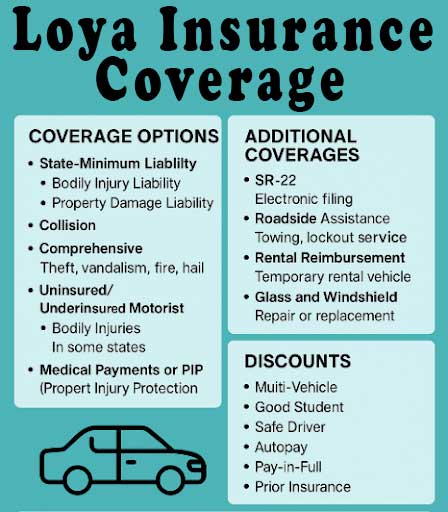
Optional coverages can vary by state, underwriting company, and local office. Fred Loya’s website lists car insurance coverage options and describes flexible plans that can be combined to create a policy that fits a driver’s needs and budget [5].
- Roadside assistance or towing and labor coverage.
- Rental reimbursement after a covered accident.
- Glass or windshield-related coverage.
- Higher liability limits above the state minimum.
- UM/UIM property damage coverage, where available.
- Different deductibles for collision and comprehensive.
What Loya Insurance May Not Be Ideal For
Loya can be useful for drivers who want basic, straightforward coverage or need help after high-risk events. However, it may not be the right fit for every driver. If you need advanced digital policy tools, bundling with home insurance, rideshare coverage, specialty classic-car coverage, new-car replacement, or broad accident-forgiveness programs, compare multiple companies before choosing.
You should also compare carefully if you own a newer vehicle, drive for work, have expensive custom equipment, or need a commercial policy. For business use, review Loya commercial auto insurance before assuming a personal policy will cover your situation.
How to Choose the Right Loya Coverage
Choosing coverage is not only about price. You need to think about your vehicle value, savings, loan or lease requirements, driving environment, and how much risk you can realistically absorb after an accident. NAIC’s consumer guide explains that liability limits and deductibles affect rates, and that a deductible is the amount you pay out of pocket before the policy pays the loss [1].
| Your situation | Coverage to consider | Why it matters |
|---|---|---|
| Older paid-off car | Liability, UM/UIM, MedPay or PIP where available | You may not need physical damage coverage, but you still need protection from liability and uninsured drivers. |
| Financed or leased vehicle | Liability, collision, comprehensive, lender-required coverages | Your lender may require physical damage coverage even if state law does not. |
| High-risk driver | Liability, SR-22 filing if required, realistic payment plan | Keeping the policy active is critical if your license depends on continuous coverage. |
| Limited savings | Higher liability limits if affordable, UM/UIM, medical coverage options | A serious accident can create bills that exceed state minimum limits. |
| Newer car with theft or storm exposure | Comprehensive and collision with a deductible you can afford | Physical damage coverage can help avoid paying full repair or replacement costs yourself. |
Before you finalize the policy, compare the quote with how to get a Loya car insurance quote and Loya insurance deductibles.
Want a Video Walkthrough?
For visual explainers, visit the Loyainsurance.org insurance video channel. Use the videos as a quick overview, then confirm policy details directly with the insurer or a licensed agent before buying.
Visit the YouTube ChannelQuestions to Ask Before Buying
Coverage questions
- What are my exact liability limits?
- Does the policy include collision and comprehensive, or is it liability-only?
- What deductible applies to collision and comprehensive?
- Is UM/UIM included, optional, or rejected?
- Is PIP or MedPay included in my state?
Cost and filing questions
- Does my lender require full coverage?
- Is an SR-22 filing required, and how much does the filing cost?
- What is the total policy cost, not just the first payment?
- Are there cancellation fees, reinstatement fees, or late payment penalties?
- Can I change coverage online, by phone, or only through an agent?
FAQ: Loya Insurance Coverage Types
Does Loya Insurance offer full coverage?
Full coverage usually means liability plus collision and comprehensive coverage. Availability, deductibles, and limits depend on your state, vehicle, underwriting company, and policy terms.
Is liability-only coverage enough?
Liability-only coverage may keep you legal, but it does not repair your own vehicle. It may make sense for an older paid-off car, but it can leave a gap if your car is financed, leased, or hard to replace.
Does Loya help with SR-22 filings?
Fred Loya publishes SR-22 insurance information and may help drivers who need state filings in supported areas. Always confirm the filing fee, timeline, and cancellation rules before buying.
Should I add uninsured motorist coverage?
UM/UIM can be important if another driver has no insurance or not enough insurance. Requirements and availability vary by state, so check your declarations page and ask how UM/UIM works where you live.
Can I lower my premium by raising deductibles?
Often yes for collision and comprehensive, but a higher deductible means you pay more out of pocket after a claim. Choose a deductible you could actually afford during an emergency.
References
- National Association of Insurance Commissioners, Auto Insurance consumer information and A Consumer’s Guide to Auto Insurance. Source↩
- Texas Department of Insurance, Auto insurance guide covering liability, PIP, UM/UIM, towing and rental reimbursement. Source↩
- National Association of Insurance Commissioners, Best practices for buying auto insurance and definitions of collision and comprehensive coverage. Source↩
- Fred Loya Insurance, SR-22 insurance information. Source↩
- Fred Loya Insurance, Car insurance coverage information. Source↩