
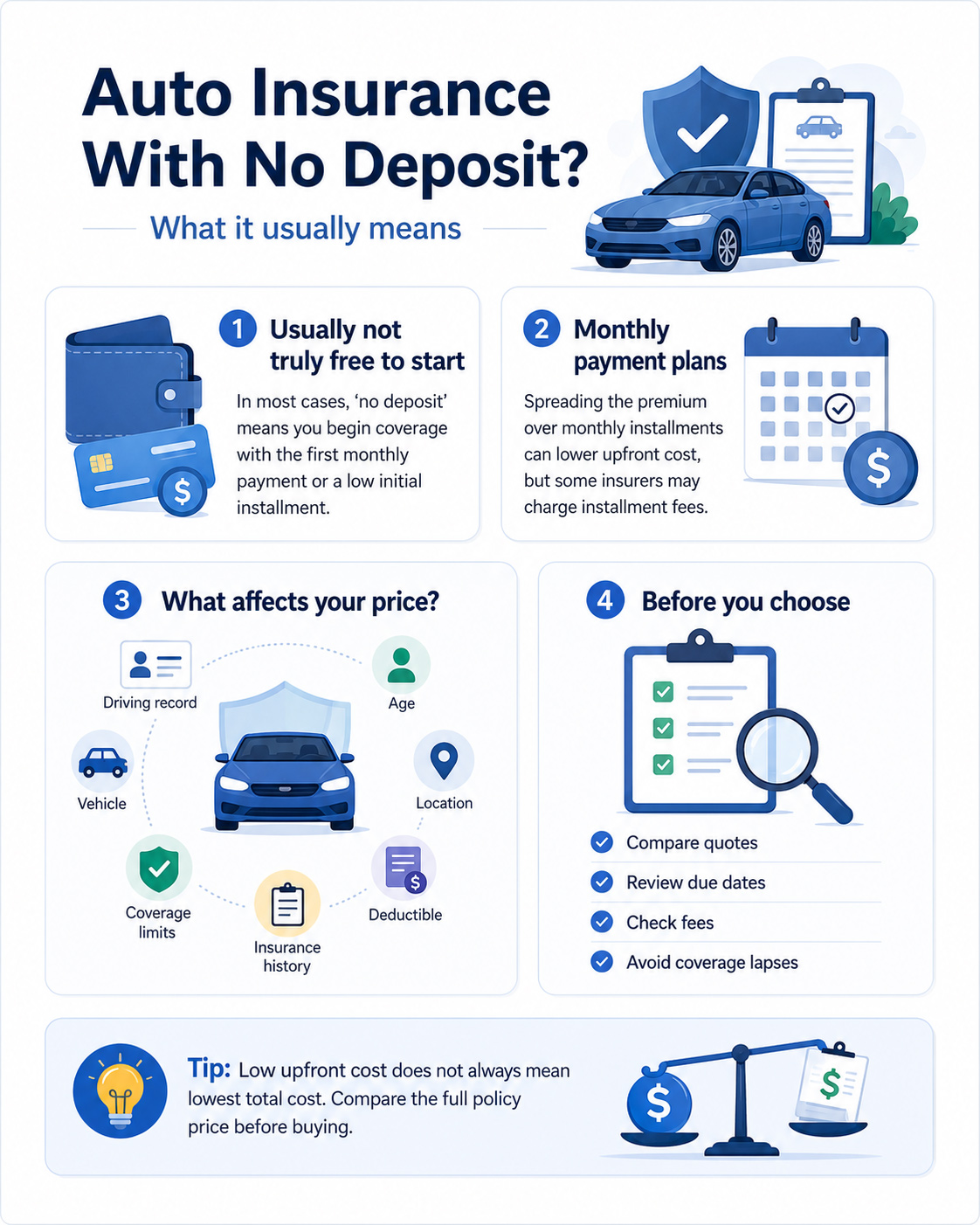
Looking for affordable auto insurance with little to no upfront cost? A no down payment car insurance plan usually does not mean coverage starts with absolutely no money paid. In most cases, it means you may be able to start a policy with the first month’s payment or a low initial installment instead of paying the full premium upfront.
Auto insurance pricing depends on factors such as your driving record, age, vehicle, location, coverage limits, deductibles, and prior insurance history. NAIC explains that auto insurance premiums are affected by multiple personal and policy factors, which is why two drivers in the same city can receive very different quotes [1].
If keeping the amount due at signup low is the priority, compare how different low-upfront-payment plans structure the first payment, monthly installments, and fees before choosing a policy.
Low First Payment
Some policies let you start coverage with a lower initial payment instead of paying the full six-month or annual premium upfront.
Monthly Installments
Monthly billing can make coverage easier to manage, but review fees and total policy cost before choosing.
Coverage Still Matters
Do not choose the weakest policy only because the first payment is low. Compare limits, deductibles, and exclusions.
How Do No Down Payment Car Insurance Policies Work?
No deposit or low-down payment auto insurance plans are structured to reduce the amount you must pay at the start of the policy. Instead of paying the entire premium upfront, you may pay the first month or an initial installment to activate coverage, then continue with monthly payments.
The phrase “no deposit” can be confusing. Many insurers still require an initial payment before coverage begins. The difference is that you may not need to pay a separate deposit on top of the first installment.
| Term | What It Usually Means | What to Check |
|---|---|---|
| No deposit | Often means no extra deposit beyond the first required payment. | Confirm the amount due today and whether fees are included. |
| Low down payment | A lower starting payment than paying the full premium upfront. | Check whether later monthly payments are higher. |
| Monthly plan | The premium is split into installments. | Review installment fees, late fees, and cancellation rules. |
| Paid-in-full | You pay the full premium for the term upfront. | May reduce billing fees, but requires more cash at the start. |
What Insurers Consider for Low-Down Payment Policies
Eligibility and pricing vary by insurer and state. Some drivers qualify for lower upfront payments more easily, while others may face higher starting costs because of risk factors, prior lapses, or required filings.
Common Rating Factors
- Driving record and recent violations.
- Previous insurance history and lapses.
- Vehicle type, age, and repair costs.
- ZIP code and local claim patterns.
- Coverage limits and deductibles selected.
- Credit-based insurance score, where allowed.
Payment Factors
- First payment required to activate coverage.
- Monthly installment amount.
- Billing or service fees.
- Late payment and cancellation rules.
- Autopay or paperless billing discounts.
- Paid-in-full discount availability.
Why Choose No Deposit Car Insurance With Monthly Payments?
Monthly payments can help drivers maintain coverage while managing a tight budget. This can be especially useful when buying a car, switching providers, recovering from a lapse, or trying to keep a vehicle legally insured without a large upfront bill.
If you are buying a vehicle soon, make sure you know when insurance needs to be in place before you drive away, especially when a lender or dealership is involved.
Budget Flexibility
Monthly billing spreads the cost over time instead of requiring one large payment.
Fast Policy Start
Coverage may begin shortly after the required first payment is accepted and the policy is issued.
Continuous Coverage
A manageable plan can help you avoid lapses, which may make future insurance more expensive.
Low Upfront Cost vs. Total Policy Cost
A low first payment can be helpful, but it is not the same as the lowest total cost. Some policies with a small starting payment may have higher monthly installments, fees, or weaker coverage. Always compare the full term.
| What to Compare | Why It Matters | Smart Question |
|---|---|---|
| First payment | Determines how much you need to start coverage. | Is this the full first month, a deposit, or an installment? |
| Monthly payment | Affects whether the policy remains affordable after it starts. | Will this amount stay the same during the policy term? |
| Fees | Installment and service fees can raise the real cost. | Are billing, late, reinstatement, or cancellation fees added? |
| Coverage limits | Lower limits may reduce price but increase financial risk. | Would this coverage protect me after a serious accident? |
Smart Ways to Save on Auto Insurance Premiums
Keeping the first payment low is only one part of saving money. You should also look for sustainable ways to lower the full premium. The Insurance Information Institute notes that factors such as your car, driving record, mileage, location, and coverage selections can affect what you pay [2].
Ways to Lower Cost
- Compare at least 3–5 quotes using the same limits.
- Ask about safe driver and multi-car discounts.
- Choose a practical vehicle with lower repair costs.
- Keep continuous coverage to avoid lapses.
- Use paperless billing or autopay if discounts apply.
- Raise deductibles only if you can afford the out-of-pocket cost.
Mistakes to Avoid
- Choosing the cheapest first payment without checking total cost.
- Dropping needed liability protection to save a few dollars.
- Missing payment due dates and risking cancellation.
- Ignoring hidden fees or short policy terms.
- Assuming every “no deposit” ad means zero dollars due.
- Skipping comparison shopping at renewal.
The III also explains that higher deductibles can reduce collision and comprehensive costs, but you should only choose a deductible you could actually afford after a claim [3].
What to Look for in a Good No Deposit Policy
A good low-down payment policy should be clear, affordable after the first month, and strong enough to meet your real driving needs. Do not focus only on the initial payment.
| Policy Feature | Good Sign | Warning Sign |
|---|---|---|
| Payment schedule | Clear first payment, due dates, and monthly amount. | Unclear fees or confusing “deposit” language. |
| Liability limits | Meets state requirements and provides realistic protection. | Limits are too low to protect you after a serious crash. |
| Deductibles | Deductible fits your emergency budget. | Deductible is so high you could not afford a claim. |
| Company support | Clear billing, claims, and policy service options. | No clear contact process or poor claims communication. |
A low first payment is still only useful if the policy provides the coverage types and limits that fit your situation. Check liability limits, physical damage coverage, deductibles, and exclusions before focusing on the amount due today.
Top Provider Types to Compare
Availability depends on your ZIP code, state rules, underwriting, and payment history. Many national and regional insurers offer monthly payment options, though they may not advertise them as “no deposit.”
National Insurers
Large carriers may offer flexible payment plans, online billing, and multiple discount options.
Regional Insurers
Regional companies may understand local rating factors and payment preferences in your state.
Non-Standard Insurers
High-risk drivers, drivers with lapses, or drivers who need an SR-22 filing often compare non-standard insurance options.
Monthly billing is available from different types of insurers, so compare providers that fit your budget and coverage needs rather than assuming the smallest first payment is the cheapest policy overall.
Avoid Scams and Misleading “No Deposit” Offers
Some ads use “no deposit” to grab attention but hide fees, weak coverage, or confusing payment terms. Before entering payment information, confirm that the company is legitimate, licensed in your state, and clear about what you are buying.
- Confirm the company or agency is licensed in your state.
- Ask for the full payment schedule in writing.
- Review coverage limits before paying.
- Check cancellation and refund rules.
- Avoid offers that promise impossible savings without checking your driving profile.
Letting a policy lapse can also create long-term costs. Going without coverage can expose you to fines, reinstatement costs, higher future premiums, and accident-related expenses, depending on your state and circumstances.
Final Thoughts
No down payment car insurance can be useful if you need affordable coverage with a manageable first payment. But the smartest choice is not always the lowest amount due today. Look at the full term, coverage limits, fees, deductibles, and whether the policy is realistic to keep active.
Compare multiple quotes, ask clear payment questions, and choose coverage that protects you beyond the first month. That approach gives you a better chance of staying insured without overpaying or leaving yourself underprotected.
References
- NAIC, auto insurance consumer information and premium factors. Source↩
- Insurance Information Institute, factors that affect the price of auto insurance. Source↩
- Insurance Information Institute, ways to lower auto insurance costs and deductible considerations. Source↩
- Insurance Information Institute, comparing policies from multiple insurers. Source↩