
The Loya Insurance Group: Coverage, Claims, Exclusions and High-Risk Driver Tips
The Loya Insurance Group is commonly associated with budget-focused auto insurance, local office access, and coverage options for drivers who may not qualify for preferred rates from standard carriers. Drivers often consider Loya-related options when they need affordable proof of insurance, higher-risk coverage, or help understanding basic policy choices.
Fred Loya’s official site describes car insurance coverage for every budget and says the company has more than 800 offices in 12 states [1]. Its older About page says the company started from a single storefront in El Paso, Texas, in 1974 [2].
The main thing drivers should understand is that “affordable” does not always mean “fully protected.” Many nonstandard policies focus on legal compliance, minimum liability, fast proof of insurance, and flexible payments. Those can be helpful, but drivers still need to review limits, exclusions, deductibles, claim steps, and optional coverages before relying on the policy.
What Is The Loya Insurance Group?
The Loya Insurance Group is best understood as a group of auto insurance-related brands and agencies connected with budget-focused and nonstandard coverage. Shoppers often encounter the name when researching Fred Loya Insurance, Loya Casualty-related topics, SR-22 support, local storefronts, and basic auto insurance policies.
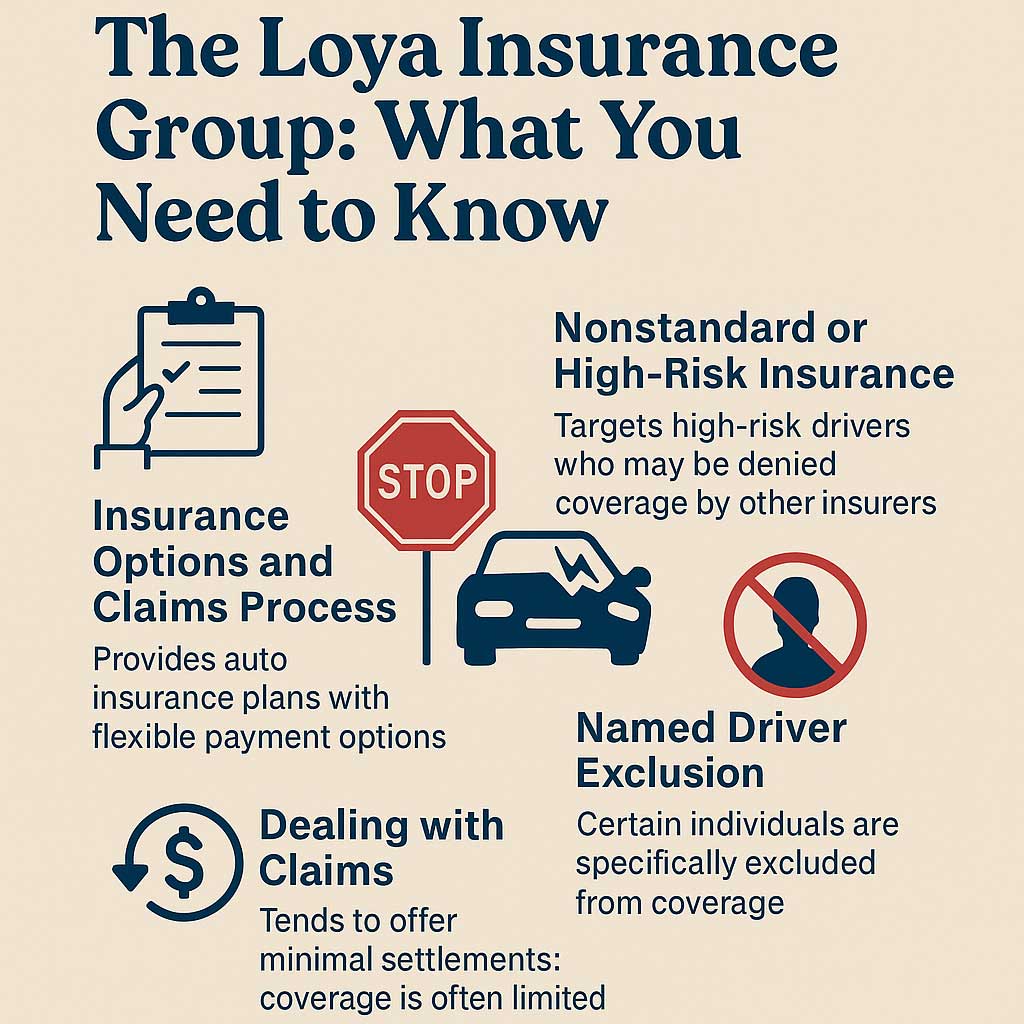
Nonstandard insurance is not automatically bad. It serves a real purpose for drivers who need coverage after tickets, accidents, lapses, limited insurance history, or other rating challenges. The key is knowing what you are buying. A policy can be legal and affordable while still having low limits, excluded drivers, high deductibles, or narrower claim benefits than a driver expected.
How Loya-Related Auto Insurance Usually Fits Drivers
Many drivers compare Loya-related options when they need to get insured quickly, keep payments manageable, or meet state requirements after a difficult driving history. That can include people who have been quoted high rates elsewhere or who need proof of insurance for license or vehicle registration purposes.
| Driver Situation | Why Loya May Be Compared | What to Check Before Buying |
|---|---|---|
| Need basic liability | Drivers may want a budget-focused policy that satisfies state requirements. | Confirm liability limits and whether higher limits are affordable. |
| Have tickets or accidents | Nonstandard carriers may quote some drivers that preferred carriers rate higher. | Ask how long violations affect rates and compare high-risk options. |
| Had a coverage lapse | Drivers may need to rebuild continuous insurance history. | Choose a payment plan you can keep active to avoid another lapse. |
| Need SR-22 support | Some drivers need proof of financial responsibility filed with the state. | Confirm filing timing, fees, and what happens if coverage cancels. |
| Prefer local service | Office support may help with documents, payments, and proof of insurance. | Call ahead to confirm office hours and services available at that location. |
Drivers with tickets, accidents, or a previous coverage lapse can face very different prices from one insurer to another. Comparing insurers that work with higher-risk drivers can help determine whether an expensive first quote is really the best available option.
Nonstandard Insurance: Helpful, But Read the Details
Nonstandard auto insurance is designed for drivers who may not fit a preferred-risk profile. It can help people stay legal and get back on the road, but it often requires extra attention to payment rules, exclusions, limits, and claims documentation.
Useful For
Drivers with tickets, lapses, SR-22 needs, limited history, or higher-risk profiles who still need coverage.
Main Tradeoff
Policies may focus on affordability and compliance more than broad optional protection.
Best Habit
Compare the declarations page, exclusions, limits, deductibles, fees, and claim rules before paying.
Coverage Types to Understand Before You Buy
Auto insurance is built from different coverage parts. The Insurance Information Institute explains that liability coverage helps pay for damage you cause to others, while collision and comprehensive can help protect your own vehicle from covered losses [3].
Liability
Helps pay for injuries or property damage you cause to others, up to policy limits. This is the core coverage required in most states.
Collision
Helps repair your vehicle after a covered crash, usually after your deductible.
Comprehensive
Helps with non-collision losses such as theft, vandalism, fire, hail, or certain weather damage.
UM/UIM
May help if another driver has no insurance or not enough insurance to pay for your damages.
Medical or PIP
May help with medical expenses after a covered accident, depending on state rules and policy terms.
Roadside or Rental
May help with towing, labor, rental reimbursement, or roadside needs if included or purchased.
Liability and uninsured motorist coverage protect against different financial risks. Comparing what liability coverage does versus protection from an uninsured driver can make it easier to decide which limits deserve the most attention when building the policy.
Minimum Limits: Legal Does Not Always Mean Enough
Many budget-focused policies are built around minimum liability limits. In Texas, the Texas Department of Insurance says drivers must carry at least $30,000 for injuries per person, $60,000 per accident, and $25,000 for property damage, commonly called 30/60/25 coverage [4].
Minimum limits can satisfy state law, but they may be too low after a serious injury crash, multi-vehicle accident, or expensive property damage claim. If the claim exceeds the policy limit, the at-fault driver may still face financial exposure beyond what the insurer pays.
| Coverage Level | What It Can Do | What It May Not Do |
|---|---|---|
| Minimum liability | Can help you meet state legal requirements and pay others up to the policy limit. | Does not repair your own car and may not cover a serious accident fully. |
| Higher liability limits | Can provide more protection if you cause injuries or property damage. | Usually costs more than minimum liability. |
| Fuller protection | May include collision, comprehensive, UM/UIM, rental, or roadside options. | Still depends on exclusions, deductibles, limits, and policy terms. |
Drivers trying to reduce the monthly bill should be careful not to trade too much protection for a lower price. Lowering Loya auto insurance costs without cutting coverage blindly can involve discounts, deductible choices, payment structure, and comparison shopping rather than automatically choosing the lowest limits.
Named Driver Exclusions: A Detail You Cannot Ignore
A named driver exclusion is a policy rule that removes coverage for a specific person. If that excluded person drives the vehicle and causes a crash, the insurer may deny coverage for that event. This is especially important in households with a high-risk driver, suspended-license history, newly licensed teen, or someone the insurer does not want to cover.
Why Exclusions Matter
- An excluded driver may not be covered even if they had permission.
- A claim may be denied if policy terms are violated.
- Household drivers should be disclosed accurately.
- Cheap coverage can become risky if exclusions are misunderstood.
What to Ask
- Are any drivers excluded from this policy?
- What happens if an excluded driver uses the car?
- Does the policy cover permissive drivers?
- Can an excluded driver be added later after their record improves?
Households where a parent owns the vehicle or policy need to make sure the listed drivers match how the car is actually used. Insuring a vehicle under a parent’s name can create problems when the policy information does not accurately reflect who regularly drives or keeps the vehicle.
Claims: How to Avoid Delays and Confusion
Fred Loya’s official claims page says claims should be reported to Loya Insurance Group at 1-800-880-0472 and lists claim reporting hours as Monday through Friday from 8:00 AM to 7:00 PM MST and Saturday from 8:00 AM to 4:00 PM MST [5]. The page also tells drivers to report claims as soon as possible after an accident.
Claims often become harder when limits are low, fault is disputed, medical bills are still developing, or documentation is incomplete. A strong paper trail can help reduce avoidable delays.
| Claim Step | Why It Matters | What to Save |
|---|---|---|
| Report quickly | Late reporting can slow the investigation and communication. | Claim number, date reported, adjuster name, and contact details. |
| Document the scene | Photos can help explain damage, location, road conditions, and vehicle positions. | Photos, videos, police report number, and accident exchange form. |
| Track expenses | Repair, towing, rental, and medical costs can support the claim file. | Receipts, estimates, bills, invoices, and repair shop notes. |
| Keep communication notes | Written records help if the claim becomes delayed or disputed. | Emails, letters, call dates, names, and summaries of conversations. |
Keeping photos, estimates, receipts, and written communication becomes especially important when the amount offered does not appear to match the documented loss. Drivers dealing with a claim settlement that appears unusually low or unfair should keep a clear record of the insurer’s explanation and the documents supporting their own estimate of the loss.
SR-22, Lapses and Staying Legal
Some drivers enter the nonstandard market because they need SR-22 proof. Texas DPS explains that an SR-22 is a Financial Responsibility Insurance Certificate used to verify that a driver maintains motor vehicle liability insurance. The insurance provider automatically notifies the department if the SR-22 is canceled, terminated, or lapses [6].
SR-22 Is Not
- A separate auto insurance policy.
- A replacement for liability coverage.
- A guarantee that collision or comprehensive is included.
- Something to ignore after the first filing.
SR-22 Requires
- An active policy that meets state requirements.
- Payments that stay current.
- Clear filing confirmation from the insurer.
- No lapses during the required period.
Practical Checklist Before Buying a Loya-Related Policy
The safest way to shop is to compare more than price. A lower monthly payment can be useful, but it should not hide low limits, excluded drivers, high deductibles, unclear fees, or claim rules you do not understand.
Policy Details
- Confirm the exact company underwriting the policy.
- Check effective date and expiration date.
- Review listed drivers, vehicles, VINs, and garaging address.
- Confirm whether any drivers are excluded.
- Compare liability limits against your financial risk.
- Check deductibles for collision and comprehensive.
Cost and Service
- Compare full-term cost, not only the first payment.
- Ask about late fees, cancellation, and reinstatement rules.
- Confirm proof-of-insurance access.
- Save customer service, claims, and roadside contact details.
- Ask about SR-22 filing fees if applicable.
- Compare at least two or three quotes using identical coverage.
When The Loya Insurance Group May Be a Good Fit
Loya-related insurance may be worth comparing if you need affordable coverage, local office support, proof of insurance, SR-22 assistance, or a nonstandard quote after driving-record issues. It may not be the best fit if you want broad bundling, premium digital tools, or the highest available liability limits without careful comparison.
| May Fit If… | Compare Carefully If… |
|---|---|
| You need basic liability coverage quickly. | You want broad coverage for a newer or financed vehicle. |
| You prefer in-person office help. | You rely heavily on online tools and app-based service. |
| You have a lapse, ticket, accident, or SR-22 requirement. | You are sensitive to claim-service reviews or complaint history. |
| You need a payment plan that fits tight monthly cash flow. | You may miss payments or need very flexible grace-period rules. |
FAQ: The Loya Insurance Group
Is The Loya Insurance Group the same as Fred Loya Insurance?
They are closely connected in public consumer searches, but you should always confirm the exact underwriting company listed on your quote, declarations page, ID card, billing documents, and claim paperwork.
Is Loya good for high-risk drivers?
Loya-related options may be worth comparing if you have tickets, accidents, a lapse, or an SR-22 requirement. Still, compare policy limits, exclusions, payment rules, claims support, and total cost before buying.
What is a named driver exclusion?
A named driver exclusion removes coverage for a specific person. If that excluded driver uses the vehicle and there is a crash, the insurer may deny the claim depending on policy terms.
Does minimum liability cover my own car?
No. Liability coverage generally helps pay for damage you cause to others. It does not repair your own vehicle after an at-fault crash. Collision and comprehensive are separate coverages.
What should I do if I need SR-22?
Confirm that the insurer can file SR-22 in your state, ask about filing fees and timing, choose a payment plan you can maintain, and avoid coverage lapses.
How can I avoid claim problems?
Report the claim promptly, save photos and documents, keep communication records, understand your policy limits, and ask how repair estimates, rental coverage, and deductibles work.
Final Takeaways
The Loya Insurance Group is best understood as part of the nonstandard auto insurance market: accessible, budget-focused, and often useful for drivers who need coverage after tickets, lapses, SR-22 requirements, or other rating challenges. The upside is availability and local support. The tradeoff is that policies may be built around minimum limits, exclusions, and stricter payment rules.
Before buying, verify the underwriting company, liability limits, excluded drivers, deductibles, optional coverages, SR-22 filing details, payment schedule, and claim reporting process. The best policy is not always the cheapest first payment. It is the policy that keeps you legal, stays active, and provides enough protection for your real driving situation.
References
- Fred Loya Insurance, official homepage with office count and state availability. Source↩
- Fred Loya Insurance, official About Us page. Source↩
- Insurance Information Institute, auto insurance basics and coverage types. Source↩
- Texas Department of Insurance, auto insurance guide and 30/60/25 minimum liability limits. Source↩
- Fred Loya Insurance, official claims page and claim reporting hours. Source↩
- Texas Department of Public Safety, Financial Responsibility Insurance Certificate SR-22 information. Source↩